For a homeowner standing nearby, asphalt driveway fumes are not dangerous in any meaningful way. The strong smell peaks in the first few hours while the mix is hot, then fades fast as it cools. The real exposure risk falls on paving crews, not residents. Stay 20 to 30 feet back during the job. Learn what to expect on paving day and how curing works.
What is actually in asphalt fumes?
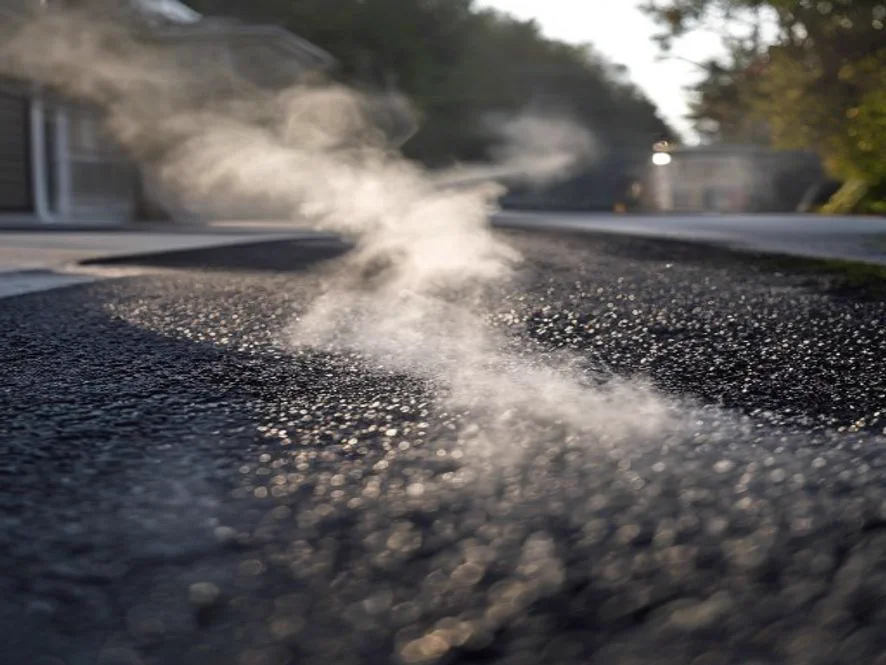
Asphalt is made from the heavy leftover part of crude oil, mixed with sand and stone. When it is heated to roughly 275 to 325 degrees Fahrenheit for paving, it gives off a vapor that contains a mix of hydrocarbons and small amounts of compounds called polycyclic aromatic hydrocarbons, or PAHs. That vapor is what you smell. Once the surface cools to outdoor temperature, it releases almost nothing.
It helps to separate two different things people lump together. Paving asphalt, the hot black mix that becomes your driveway, is fairly low in the more concerning compounds. Coal tar, an older sealcoat material, is much higher in PAHs and has a sharper chemical bite. They are not the same product, even though both are dark and smell strong. The National Asphalt Pavement Association covers this distinction in its industry materials at asphaltpavement.org.
Are the fumes dangerous to a homeowner?
For someone living next to a new driveway, the answer is no, not in any practical sense. The amount of vapor that reaches you outdoors is small, it disperses into open air within seconds, and your total exposure is measured in hours, not years. The strong smell can trigger a headache, a scratchy throat, or watery eyes in sensitive people, but that is irritation from the odor, not a sign of harm.
The picture is different for paving workers. They stand over hot asphalt all day, every working day, for years. Because of that repeated, close, high concentration exposure, the U.S. government regulates their air. The Centers for Disease Control and Prevention summarizes the occupational research at cdc.gov, and the Occupational Safety and Health Administration sets workplace limits described at osha.gov. The key takeaway for you: the rules exist to protect crews who breathe this for a living, not the family who watches one driveway get paved.
- Dose makes the difference. Risk comes from concentration multiplied by time. A crew gets a high dose over years. You get a tiny dose over hours.
- Outdoor air dilutes fast. Vapor that would be a concern in a closed shop scatters within feet in open air.
- The smell outlasts the risk. A faint odor on a hot day weeks later is not a meaningful exposure, it is just warm asphalt off-gassing trace amounts.
How long do the fumes last?
Timing tracks temperature. The hotter the surface, the more it off-gasses, so the smell follows the cooling curve. Here is the rough timeline most homeowners see.
- First few hours: The mix is still hot. This is the strongest smell and the only window where standing right over it would matter.
- 24 to 72 hours: A noticeable but fading odor, stronger in heat and direct sun, lighter overnight and on cool days.
- By the time you can park, about 2 to 3 days: The fumes are nearly gone. See when you can park on a new driveway for the full curing window.
- Hot afternoons for a week or two: A faint smell can briefly return when the sun heats the surface. This is normal and harmless.
Heat and humidity both stretch the timeline. A driveway paved in a 90 degree heat wave will smell longer than one paved on a mild 60 degree day. If you want to understand why crews care so much about temperature, our guide on the best time to pave a driveway walks through it.
Sealcoat fumes are a separate question
If your fume worry is really about that sharp chemical smell, you may be thinking of sealcoat, not paving asphalt. Sealcoat is the thin protective coat applied later. The material you pick matters a lot here. Coal tar sealer is high in PAHs and smells harsh. Asphalt emulsion sealer is lower odor and lower in those compounds. The U.S. Geological Survey and several cities have studied coal tar runoff, and many areas now restrict it. If fumes drive your decision, read coal tar vs asphalt emulsion sealer and the sealer types comparison guide before you buy.
For broader environmental context on coatings and runoff, the Environmental Protection Agency publishes consumer guidance at epa.gov.
Quick check
Fume Exposure Comfort Estimator
Answer three quick questions to gauge how cautious you need to be on paving or sealing day. This is a comfort guide, not medical advice.
How to stay safe and comfortable
None of this requires evacuating your home. A few simple habits keep the smell out of your living space and protect anyone who is sensitive to odors.
- Keep a buffer during the hot phase. Stand 20 to 30 feet back while the crew works. Let them handle the part right over the mat.
- Close windows on the driveway side. Do this for the first day so the odor does not drift indoors.
- Mind your HVAC intake. If your fresh air intake sits near the driveway, switch the system to recirculate during paving.
- Keep kids and pets in until it cools. See new asphalt safety for pets and how long before kids play on it.
- Pick the lower odor sealer. Choose asphalt emulsion over coal tar if smell or chemicals concern you.
- Pave in mild weather when you can. A cooler day means less off-gassing and a faster fade.
If you are still in the planning stage, knowing the full cost and timeline helps you schedule the work for a mild week. Run the numbers with our asphalt driveway cost calculator or size the job with the asphalt calculator.
Bottom line
Asphalt driveway fumes smell alarming, but for a homeowner the actual risk is low and short lived. The vapor peaks in the first few hours, dilutes fast outdoors, and fades within a couple of days. The people who truly need protection are the crews, which is why worker exposure is regulated. Keep a buffer, close your windows on the driveway side, keep kids and pets in until the surface cools, and pick an asphalt emulsion sealer over coal tar if smell is your concern. Do that and a new driveway is a safe, normal home improvement.